
In this article Easify lead QA Alison Moore talks about how you can use the built in Easify knowledgebase to store your valuable company information.
"Whether it's recording your VAT number, writing notes about a specific task or a staff handbook, the knowledge base is an ideal place to keep it."
Keep it in the Knowledge Base
Easify has an in-built knowledge base – this is somewhere where you can store any useful information about your company. Whether it’s recording your VAT number, writing notes about a specific task or a staff handbook, the knowledge base is an ideal place to keep it.
The list of things you can keep in your knowledge base is literally endless, especially as you can add whichever Knowledge Base Categories you choose:
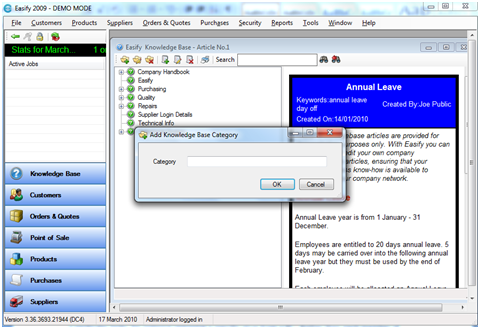
However here are some ideas as to what you could use the knowledge base for:
- Recording useful information such as reference numbers such as your PAYE & NI reference, your company registration number, your VAT number, your insurance policy reference etc. This is ideal as it gives you a ‘one stop place’ to record your data and people can look up information themselves without the delay of having to track down the person in the company who normally deals with it.
-
Recording website logins so all your usernames and password hints and clues are in the same place.
Tip You cannot set access rights to specific articles or categories in the knowledge base so you probably wouldn’t want to store anything highly classified in here. However it might be the common practice for the accounts department to always the same password, so you could store the username for a website with the hint of ‘our usual password’. Anyone outside the accounts department won’t know what the usual password is, so the security hasn’t been breached.
- As a company handbook entering information about internal policies such as annual leave, sick leave, company cars, use of company property. Although it might be your business practice to email or write to staff in the first place, it is useful to record the policy in the knowledge base as staff can refer to it if they have a question in the future. Again, it cuts down on delay as staff do not have to hunt down the person who knows the answer.
- Recording information about a particular task. For instance, some tasks are only done yearly such as the company annual return or tax assessment, so there might be certain things that you forget from one year to the next. By adding notes, hints and pointers in the knowledgebase it means that you don't need to "re-learn" it every year but can remind yourself how to do it.
- Sharing knowledge across the company or within each department, whereby you can add knowledge base categories based on departments. For instance you might work in the technical department and after much pain staking research you’ve worked out how to remove a specific virus from a PC. Rather than each team member having to work this out themselves, the engineer can write a knowledge base article and share his findings with other engineers.
As long as you get in the habit of using the knowledge base by adding information as you think about it, and by checking it whenever you have a question, the Knowledge Base can become an invaluable tool within your company. Some businesses have intranets which perform a similar role, but unless you have the expertise in-house, they can be expensive to set up and difficult to maintain. What is great about Easify’s knowledge base it that anyone can add a knowledge base article very easily, without needing extra software or having specific training.
When writing an article with the in-built text editor you can easily select a Category, add a Title and then type in your article.
It is also advisable to add keywords for the article as this will make it easier for people to find in the future.
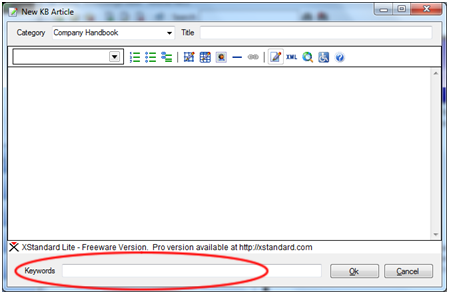
Easify also records who has written the article and when, plus if the article is updated it records when it was last updated.
You can also easily edit articles and delete them (as long as you have permission to do so – please see the comprehensive Easify UserGuide for more information on how to set permissions.)
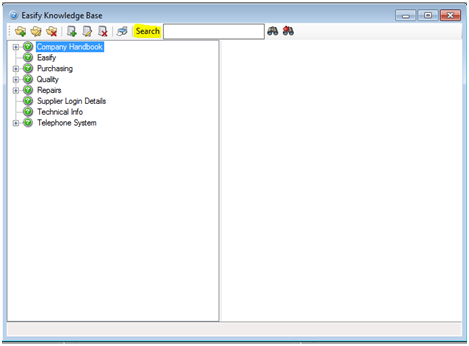
Easify's knowledge base also has a search function allowing you to search on keywords or descriptions to see if the information is stored on the knowledgebase.
There also might be certain members of staff that you don’t want accessing your knowledge base such as contractors or temporary staff so you can un-assign access to the knowledge base through the security settings.